
Tick Season in the Lehigh Valley: What's Changed and How to Protect Your Family
The Expanding Tick Season
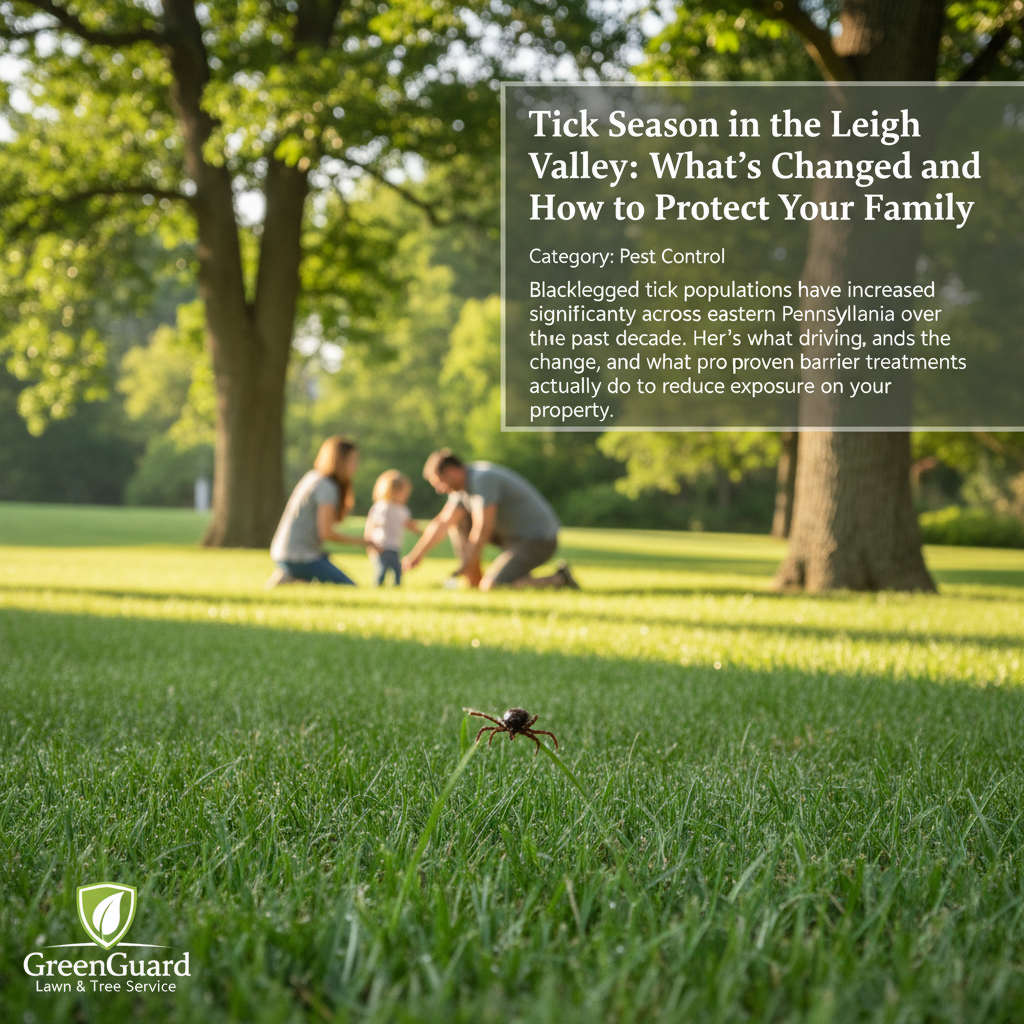
Two decades ago, tick season in Pennsylvania was roughly May through August. Today, blacklegged ticks (Ixodes scapularis) — the primary vector for Lyme disease — are active any time temperatures are above 35°F. That means ticks are a year-round concern across the Lehigh Valley, with peak activity in spring (May–June) and fall (September–October).
Why Tick Populations Are Increasing
Several factors have converged to drive higher tick densities in our region:
- Increased deer populations — Blacklegged ticks require deer as adult hosts. Suburban deer populations in the Lehigh Valley have grown significantly over the past 20 years.
- Milder winters — Fewer prolonged cold snaps means higher overwinter tick survival rates.
- Fragmented forest edges — Tick habitat is highest at the interface of lawn and wooded or brushy areas — exactly the conditions on many suburban properties.
- Expanding white-footed mouse populations — The primary reservoir for Lyme bacteria, mice are increasingly abundant in our area.
Risk Zones on Your Property
Not all parts of your yard carry equal risk. Tick encounter rates are highest in:
- Wooded borders and brush edges — particularly within 9 feet of the lawn-woodland interface
- Leaf litter accumulations
- Stone walls and wood piles — harborage for mice
- Unmaintained ground covers like pachysandra and English ivy
How Perimeter Barrier Treatments Work
Professional perimeter spray treatments use pyrethroid or bifenthrin chemistry applied to:
- Lawn edges bordering wooded areas
- Ground cover beds
- Foundation plantings
- Other tick harborage zones
These treatments do not eliminate ticks from your property — adult ticks can migrate back from adjoining properties. What they do is dramatically reduce the tick population in the zones where human exposure is most likely. Studies from the CDC and university entomology departments have consistently shown 70–90% reductions in tick encounter rates in treated yards.
Timing
For maximum protection:
- First application: late April / early May — targets nymphal ticks, which are the highest-risk life stage (nymphs are tiny, often missed during tick checks, and responsible for the majority of Lyme transmissions)
- Second application: late September / early October — targets adult ticks entering their fall active period
- Optional mid-summer application for high-exposure properties
Personal Protection Still Matters
Barrier treatments are one layer of protection, not a complete solution. The CDC still recommends:
- Wearing light-colored clothing to spot ticks easily
- Using DEET or permethrin repellents in high-risk areas
- Conducting daily tick checks on children and pets
- Showering within 2 hours of outdoor activity during tick season