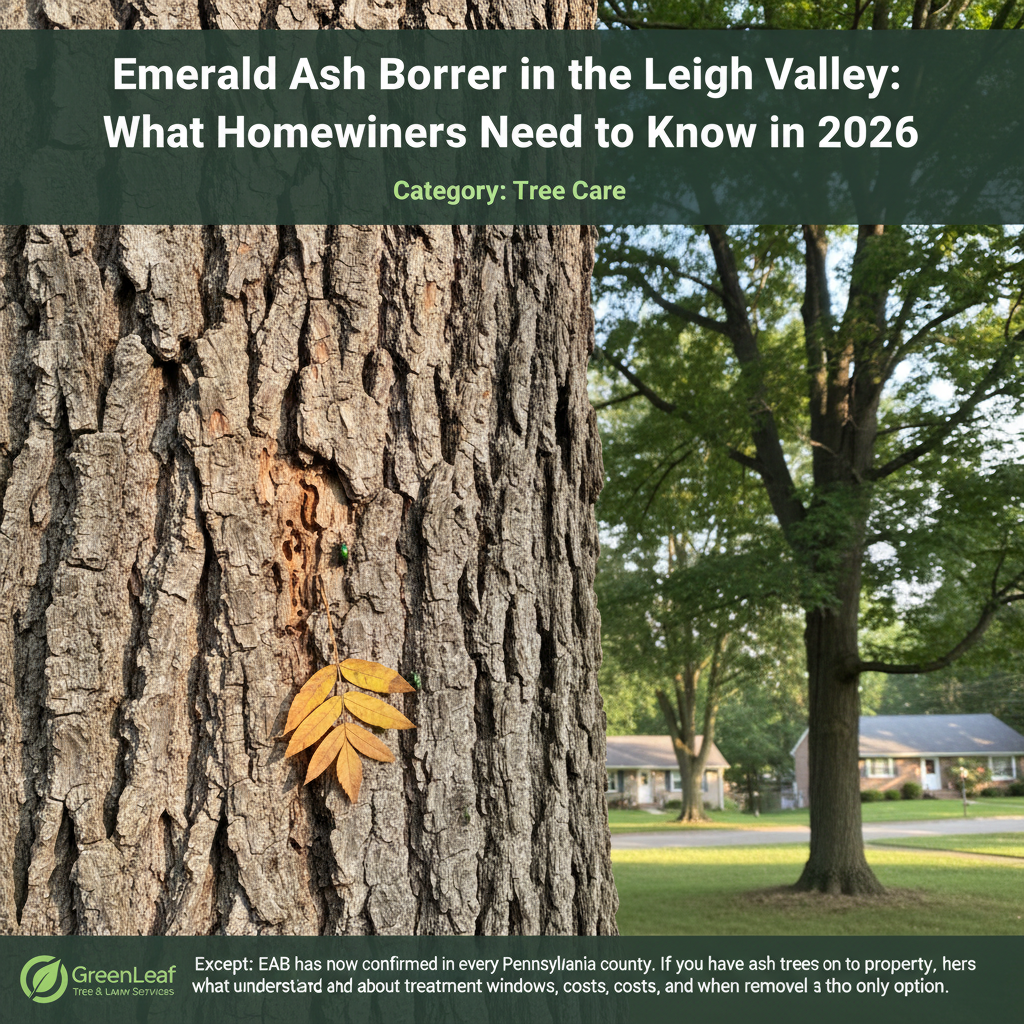
Emerald Ash Borer in the Lehigh Valley: What Homeowners Need to Know in 2026
The Situation in Pennsylvania
Emerald ash borer (EAB) has been confirmed in all 67 Pennsylvania counties as of 2024. The invasive beetle has killed hundreds of millions of ash trees across North America, and the Lehigh Valley has not been spared. What was once a scattered threat is now a near-certainty for any ash tree without active protection.
Identifying Your Ash Trees
Ash trees (Fraxinus spp.) are identified by:
- Opposite, compound leaves with 5–9 leaflets
- Diamond-pattern bark on mature specimens
- Paddle-shaped seeds (samaras) that hang in clusters
- Opposite branching pattern
Green ash and white ash are the most common species in Lehigh Valley landscapes.
Signs of Active EAB Infestation
- Crown dieback starting at the top of the canopy
- S-shaped serpentine galleries visible under peeling bark
- D-shaped exit holes roughly 3–4mm wide
- Epicormic sprouting — vigorous shoots growing from the trunk base or main scaffold branches (the tree's stress response)
- Woodpecker damage — woodpeckers excavate bark to feed on EAB larvae
Treatment: The 30% Rule
The generally accepted guideline among arborists is that ash trees with 30% or less canopy dieback are good treatment candidates. Trees beyond that threshold are increasingly difficult to save and present escalating structural risks as the crown continues to fail.
Effective treatments include:
- Emamectin benzoate trunk injection (TREE-äge or TreeAzin) — 2-year protection, most effective for advanced infestations
- Imidacloprid soil drench — Annual application, effective for preventive and early-stage treatment
- Dinotefuran basal bark spray — Fast-acting, applied to the lower 12 inches of trunk
When to Remove
Once an ash tree exceeds 50% canopy loss, structural integrity becomes a serious concern. EAB destroys the cambium layer just under the bark — the tissue responsible for conducting water and structural support. Ash trees with heavy infestations can fail suddenly, with large scaffold branches breaking without warning.
Cost Comparison
For a medium-sized ash tree (30–40 feet), treatment typically runs $200–$400 per 2-year cycle. Removal of a similar tree typically costs $800–$1,500 depending on access. Treatment is almost always the better value for healthy trees with access to an arborist.
Our Recommendation
If you have ash trees on your property that haven't been assessed recently, schedule an evaluation this spring. Early identification and treatment dramatically changes outcomes — and treatment is far less expensive than removal and replacement.