
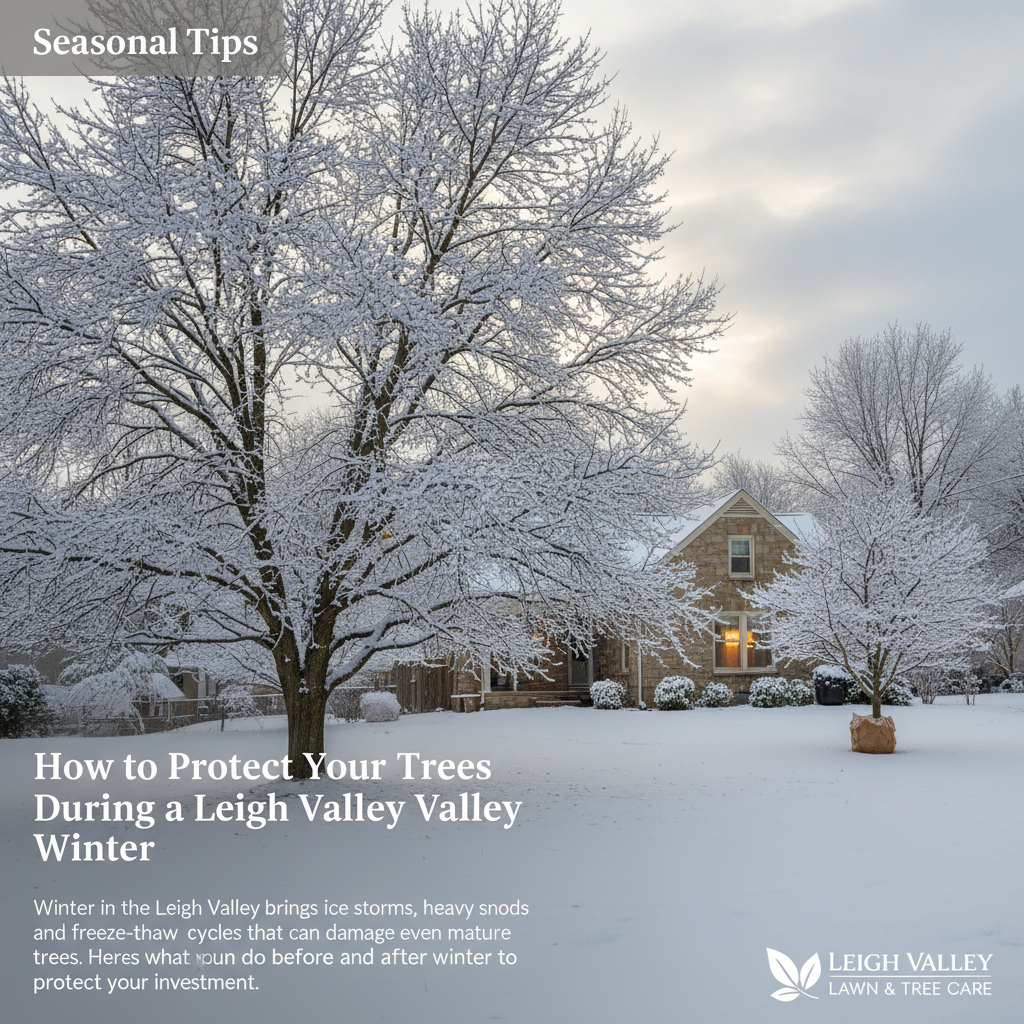
How to Protect Your Trees During a Lehigh Valley Winter
The Real Winter Threats
Winter causes tree damage in three primary ways: mechanical loading from ice and snow, desiccation of broadleaf evergreens, and frost cracking on thin-barked trees. Understanding which threats apply to your specific trees helps prioritize what to protect.
Ice and Snow Loading
The Lehigh Valley regularly experiences ice storms — freezing rain events that coat branches in up to an inch of ice. A single mature branch can accumulate hundreds of pounds of ice load in a severe event.
Vulnerable trees:
- Arborvitae and juniper — columnar forms that split under snow load
- Multi-stem ornamentals with included bark
- Bradford pear (highly susceptible to structural failure)
- Any tree with codominant stems or previous crown damage
What helps:
- Structural pruning in fall to reduce sail area and remove weak attachments
- Cabling and bracing systems installed by a certified arborist for high-value multi-stem trees
- Never shake ice-laden branches — the sudden movement causes more breakage than the ice load itself
Winter Desiccation of Evergreens
Broadleaf evergreens — rhododendron, cherry laurel, holly, and boxwood — continue to transpire water through their leaves all winter. When the ground is frozen, roots cannot replace that moisture, and leaf scorch results.
Prevention: Apply an anti-desiccant spray (Wilt-Pruf or similar) in late November, before temperatures drop below 40°F consistently. Reapply in late January or early February. Anti-desiccants form a thin waxy film on leaf surfaces that reduces transpiration by up to 30%.
Frost Cracking
Thin-barked trees — maples, honey locusts, and cherries most commonly — can develop vertical cracks in the trunk during rapid freeze-thaw cycles. These cracks (called frost cracks or radial shakes) develop when outer wood contracts faster than inner wood during sudden temperature drops.
Frost cracks typically heal over during the growing season, but they can create entry points for decay fungi. If you notice long vertical cracks after a cold snap, have an arborist evaluate them in spring.
After an Ice or Snow Event
- Assess before you touch anything. What looks like a broken branch may be held in place by others — premature removal can cause a cascade failure.
- Do not attempt to remove ice-laden branches yourself. The stored energy in a bent or fractured branch is significant.
- Broken stubs should be properly pruned to the branch collar as soon as the weather allows. Ragged breaks are entry points for decay and insects.
- Call us for any tree resting on a structure, fence, or utility line — these are emergency situations.